
In its 77th year, The Food Retailing Industry Speaks 2026 report explores what’s happening in the food industry, including key factors in the business, operations challenges and innovative strategies.
By: Steve Markenson, Vice President, Research & Insights, FMI
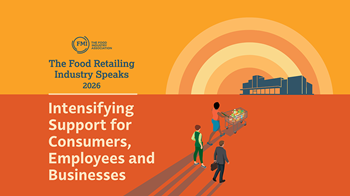 The evolving and dynamic food industry never stands still. In its 77th year, The Food Retailing Industry Speaks 2026 report continues to chronicle what the industry is doing to overcome obstacles and innovate in support of shoppers. Amid a host of macro challenges, the food industry is pursuing key strategies for success, including addressing customer needs, optimizing shopper experiences and bolstering business resiliency.
This signature FMI report is also loaded with important facts that serve to frame what is happening in the industry and provide key benchmarks for FMI members to measure themselves against. These include:
Key Factors in the Business
- Transactions: About 60% of grocery store transactions took place at regular cashier lanes, and one-third were at self-checkout lanes.
- Competition: Food retailers identified club stores and supercenters as the formats having the biggest competitive impacts on their businesses.
- Ecommerce: Food retailers reported improved online shopping results for 2025, including in overall sales, share of sales and percent of retailers reporting ecommerce profitability.
- Workforce: In 2025, food retailers and suppliers reported fewer workforce challenges than in previous years, with negative sentiment around recruitment and retention dropping from 52% to 26% among retailers.
- Out-of-Stocks: Food retail out-of-stocks remained at relatively low rates, at 5.8% in 2025, compared to 10.7% in 2022.
Operations Challenges
- The Macro Environment: Industry attitudes were more negative in 2025, with most responding retailers and suppliers pointing to the challenging impacts of inflation and the economy. In addition, about 90% of responding food retailers and suppliers felt negative impacts from international trade and tariffs.
- Supply Chain: Two-thirds of food retailers and 70% of suppliers pointed to negative impacts on their businesses from supply chain challenges in 2025.
- Swipe Fees: Use of credit and debit cards represented 81% of sales in 2025, up significantly over the past decade. These forms of payment are costly, as credit and debit swipe fees directly impact profits.
- Profits: Food retail profit margins in 2025 were up slightly at 2.1%, as gross margins remained low, and investments in staff through payroll and employee benefit costs increased.
- Supplier Concern: The biggest competitive challenges cited by suppliers were from private or store brands.
- Health Care Costs: These costs increased in 2025 by an average of 5.7% for food retailers. Most food retailers and suppliers anticipate their health care costs will increase in 2026.
- Asset Protection: Theft and fraud were identified as among the biggest challenges impacting food retail businesses in 2025, with 84% of retail respondents pointing to this.
Innovative Strategies
- Community Support: Ninety-three percent of food retailers have quantified goals and implementation time frames for charitable donations, and 82% have this for community outreach programs.
- Differentiation: Among the three most significant food retailer product differentiation strategies employed in 2025, 89% operated fresh prepared/foodservice programs, 87% sold local assortments and 85% leveraged organic assortments throughout the store.
- Technology: Most food retailers have incorporated data analytics for activities such as assortment planning and replenishment, leveraging customer data, and pricing and promotion. Additionally, nearly one-third of responding food retailers say they are using artificial intelligence for these activities.
- Communications: Food retailers are embracing a mix of online and in-store strategic approaches to marketing and communications platforms. This mix is captured in the top two approaches used by retailers — Facebook (97%) and in-store signage (95%).
- Health and Well-being: In 2025, 76% of food retailers employed product differentiation strategies for nutrition, health and well-being, and 74% offered products with beneficial nutrition attributes for health and well-being.
- Supplier Innovation: The most widely used product differentiation strategies by suppliers in 2025 were product innovation (100%); products with beneficial attributes for health and well-being (76%); and focus on nutrition, health and well-being (76%).
We explore all of this and much more in this year’s report. To dive deeper, download The Food Retailing Industry Speaks 2026. For those of you who are data geeks like me, you can also download the data table and charts.
 Industry Topics address your specific area of expertise with resources, reports, events and more.
 Our Research covers consumer behavior and retail operation benchmarks so you can make informed business decisions.
 Events and Education including online and in-person help you advance your food retail career.
 Food Safety training, resources and guidance that help you create a company food safety culture.
 Government Affairs work — federal and state — on the latest food industry policy, regulatory and legislative issues.
 Get Involved. From industry awards to newsletters and committees, these resources help you take advantage of your membership.
 Best practices, guidance documents, infographics, signage and more for the food industry on the COVID-19 pandemic.
