
FMI’s U.S. Grocery Shopper Trends 2026: Return to Routine tracks evolving consumer behaviors in the food retail industry, revealing that inflation and affordability are driving shoppers toward home-prepared meals and grocery-sourced lunch options that balance financial constraints with health and wellness goals.
By Steve Markenson, Vice President, Research & Insights, FMI
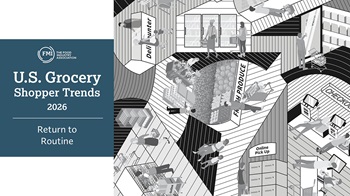 Grocery shoppers are still feeling the pressure of affordability and inflation — and it’s changing the way Americans think about lunch and dinner. New findings from FMI’s U.S. Grocery Shopper Trends 2026: Return to Routine reveal a renewed focus on home-prepared meals as shoppers embrace new routines and return to familiar ones. For many, cooking at home is more than a way to stretch the grocery budget; it’s also a practical way to support health goals and bring families together around the table.
Lunch Remains a Strategic Meal
While dinner often receives the most attention, lunch has become increasingly important in our daily routines. For working Americans, lunch is viewed less as a simple refueling opportunity and more as a chance for a break in the day and an opportunity for a reset. Nearly eight in ten working Americans say workday lunch serves as a welcome break or helps them shift gears for the rest of the day.
The vast majority of lunches are now sourced through food retail. When working away from home, 68% of lunches come either from home-prepared food or ready-to-eat options purchased from food retailers. For those working from home, food retail's share rises to 79%. Homemade lunches are dominant in both settings.
Why Are Shoppers Choosing Home-Sourced Lunches?
Cost remains the leading reason for adults' and children’s lunches with food prepared at home. Roughly six in ten workers who make or bring lunch from home cite cost savings as a key motivator. Convenience and health also play major roles, with many shoppers believing homemade lunches are easier, healthier and a good way to use leftovers.
We found that prepared foods from grocery stores also have a place in today's lunch routine. Shoppers who purchase prepared, ready-to-eat or ready-to-heat lunches from stores do so largely because they are fast and convenient, suggesting retailers have an opportunity, as many are, to expand fresh foodservice grab-and-go offerings.
Lunch and Dinner Habits Shift to Home
A notable trend in 2026 is the resurgence of meals prepared and consumed at home. Nearly one-half of shoppers (44%) say they are having more family meals at home than a year ago, while more than one-third (35%) report cooking more often. At the same time, one-half of shoppers say they are eating fewer restaurant meals and ordering less takeout and delivery for their families. Family meals at home rank highly as a meal behavior shoppers expect to continue into the future.
Why Are Americans Eating More at Home?
Their motivations to eat at home are easy to understand. While shoppers continue to face affordability pressures, they increasingly view meals at home as offering multiple benefits beyond just cost savings. Family meals are seen by shoppers as being healthier, more balanced and more enjoyable than meals eaten alone. Many shoppers also believe shared meals create opportunities for meaningful conversation and stronger family connections.
In fact, 91% of shoppers acknowledge family meals provide benefits, and two-thirds say those benefits outweigh the time and effort required to plan, shop for, prepare and clean up after meals. Those who see family meals as worthwhile are significantly more likely to feel connected to loved ones than those who do not.
Dinner Is About More Than Food
Dinner continues to occupy a special place in family life. Shoppers overwhelmingly associate family meals with social and emotional benefits. Seventy-two percent say family meals help teach respectful interactions, while 65% believe meals together create a safe environment to discuss difficult topics. Three-quarters of shoppers say homemade meals make it easier to include nutritious options.
Notably, family meals are becoming an antidote to some of the anxiety and uncertainty felt elsewhere. Even as 70% of shoppers report that their income has failed to keep pace with inflation, many continue prioritizing the family dinner table as a place for connection, value and wellness.
What Are the Opportunities for Food Retailers?
The research points to significant opportunities for food retailers. Shoppers seek help making lunch and dinner easier without sacrificing health or value. Their top request is better-value lunch options, followed by healthier, fresher, more varied and better-tasting prepared foods.
For retailers, the message is clear: today's shoppers are increasingly committed to meals at home, but they are looking for partners who can help simplify planning and preparation. Whether through meal solutions, fresh prepared foods, lunch kits or budget-friendly offerings, retailers have an opportunity to support consumers' desire to eat well, save money and spend more meaningful time together. The results can be positive on all sides.
Join us for the Back to Routine with Family Meals webinar that dives deeper into these findings on Wednesday, August 26.
Download U.S. Grocery Shopper Trends 2026: Return to Routine
 Industry Topics address your specific area of expertise with resources, reports, events and more.
 Our Research covers consumer behavior and retail operation benchmarks so you can make informed business decisions.
 Events and Education including online and in-person help you advance your food retail career.
 Food Safety training, resources and guidance that help you create a company food safety culture.
 Government Affairs work — federal and state — on the latest food industry policy, regulatory and legislative issues.
 Get Involved. From industry awards to newsletters and committees, these resources help you take advantage of your membership.
 Best practices, guidance documents, infographics, signage and more for the food industry on the COVID-19 pandemic.
