
FMI’s GroceryLab will help organizations succeed with new technology by uniting cross‑functional teams and early adopters to redesign real workflows before scaling enterprise‑wide.
By: Jennifer Shawgo, Senior Director, Technology Strategy & Programs, FMI
 The food industry invested more than $10 billion in technology in 2024. Many projects could fail because organizations deploy siloed and top-down without understanding how work actually gets done. The upcoming FMI GroceryLab forum helps fix that.
Before allocating another dollar to technology in 2026, answer this question: Can you name the three highest-performing early adopters in merchandising, marketing, and operations who will model the workflow changes? If not, the organization isn't ready to deploy anything new.
The Pattern That Keeps Failing
Here's what happens in most organizations: A commercial leader works on strategy. Technologists evaluate platforms. They come back to the office and try to reconcile incompatible visions. A top-down rollout follows. Training sessions happen. Enterprise-wide launch. Then engagement drops after two weeks because no one actually changed how they work.
The technology isn't the bottleneck anymore. Technology could completely unravel existing processes, procedures and how people work. The people part of technology is at least 70 percent of the equation. Yet most organizations keep investing in tools while ignoring the harder work of organizational readiness.
Change Happens at Multiple Levels
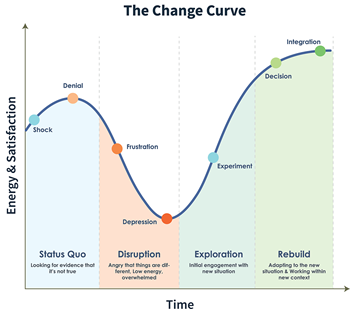
Change doesn't happen at one level. It happens simultaneously across multiple groups, each moving through their own emotional journey. Organizations go through predictable stages of resistance, exploration and eventual adoption. The Kübler-Ross change curve applies to technology deployment just as it does to any major transition.
An executive attending a traditional conference will have their moment of clarity about what needs to change. Some are the top decision makers who can allocate resources and set direction. Others report to a CEO or board that hasn't had that realization yet. Either way, the organization they return to is on a different timeline. Functional teams who actually have to change their workflows are on yet another timeline entirely.
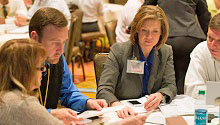
All three levels need to move together. That's why GroceryLab brings cross-functional teams from the same organization into the room from day one. Merchants, marketers, technologists and operations leaders working on the same problems, having the same realizations. They don't go home alone to evangelize; they go home as a unified team.
Top-Down and Bottom-Up
Executive leaders set the vision. But many don't have an intimate understanding of how the work actually gets done. The best deployment approach isn't a top-down mandate. It's identifying the highest-performing early adopters within each function, letting them experiment and model what works in real workflows, then deploying horizontally across the function before scaling vertically.
This requires executives to acknowledge what they don't know. It requires giving early adopters permission to test and fail. It requires patience to model workflows before mandating adoption. Many organizations skip straight to the enterprise rollout and wonder why it doesn't stick.
What GroceryLab Does Differently
GroceryLab isn't a conference. It's a hands-on forum where decision makers learn to work from the bottom back to the top. Attendees leave understanding which workflows are suited for automation, which require human judgment, and how to structure deployment so change actually happens – not just how a point solution or tech stack can theoretically work.
The focus is tactical experience workshops, not keynote speeches. They work through use cases with their cross-functional peers. They see how technology enables execution when it's deployed with organizational readiness, not in spite of it.
The Right People on Your Team, Together at the Table
If the organization can't identify its highest-performing early adopters by function, that's the first readiness problem to solve. To fully capitalize on the value GroceryLab will provide, executive teams should be able to answer that question first.
Join us at GroceryLab, June 2-4, in Detroit. Limited spots are available.
 Industry Topics address your specific area of expertise with resources, reports, events and more.
 Our Research covers consumer behavior and retail operation benchmarks so you can make informed business decisions.
 Events and Education including online and in-person help you advance your food retail career.
 Food Safety training, resources and guidance that help you create a company food safety culture.
 Government Affairs work — federal and state — on the latest food industry policy, regulatory and legislative issues.
 Get Involved. From industry awards to newsletters and committees, these resources help you take advantage of your membership.
 Best practices, guidance documents, infographics, signage and more for the food industry on the COVID-19 pandemic.
