

By: Robert Rosado, Director or Government Relations, Food Marketing Institute
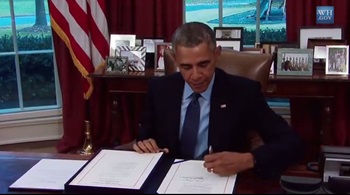
On Tuesday, President Obama signed the Bipartisan Budget Act of 2015 (P.L. 114-74) into law, a budget deal that provides relative government budget clarity for the next two fiscal years and suspends the debt limit until March 2017, among other things. The Budget Act also contains language that removes an Affordable Care Act (ACA) requirement for businesses with more than 200 employees to automatically enroll full-time employees in health coverage after working 90 days even if the employee doesn’t opt-in or choose coverage. FMI strongly supported preemptively stopping the auto-enrollment mandate and worked with both Republicans and Democrats for its inclusion in the budget agreement before agencies began writing regulations.
Eliminating mandatory auto-enrollment does not reduce individuals’ access or eligibility for health care coverage, but it removes the potential for redundancies. The auto-enrollment clause would have resulted in unwanted dual-enrollment for those employees receiving health coverage through other means and would have forced both employees and employers to pay dual premiums.
Recognizing the problems associated with automatic enrollment, the Department of Labor delayed the regulation’s implementation in February 2012, but the employer requirement still existed despite no clear compliance timeline from the Obama Administration. Lawmakers have introduced bills in past Congresses to fully repeal the ACA provision, and FMI has been supportive and closely involved with these efforts. FMI participates on the Executive Committee of the Employers for Flexibility in Health Care (E-FLEX), a coalition of leading trade associations and businesses, which has been highly engaged with congressional offices on both sides of the political spectrum to raise awareness of this redundant requirement and its unintended negative impact on employees.
The auto-enroll repeal is a significant win given the polarizing nature of health care related issues in Congress and will help our member companies and associates ensure they are not paying for redundant coverage that they do not need. FMI will continue to work with lawmakers and regulators as implementation moves forward with the many other ACA employer requirements to ensure our members have the flexibility to provide affordable and quality health coverage to their employees.
 Industry Topics address your specific area of expertise with resources, reports, events and more.
 Our Research covers consumer behavior and retail operation benchmarks so you can make informed business decisions.
 Events and Education including online and in-person help you advance your food retail career.
 Food Safety training, resources and guidance that help you create a company food safety culture.
 Government Affairs work — federal and state — on the latest food industry policy, regulatory and legislative issues.
 Get Involved. From industry awards to newsletters and committees, these resources help you take advantage of your membership.
 Best practices, guidance documents, infographics, signage and more for the food industry on the COVID-19 pandemic.
