


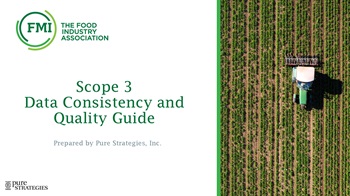
FMI’s Scope 3 Data Quality and Consistency Guide provides food retailers and suppliers with practical recommendations to improve greenhouse gas emissions data, standardize measurement and reporting, strengthen supplier engagement and support more informed sustainability decisions across the food industry.
By: Julie Savoie, Senior Director, Workforce, Talent & Sustainability, FMI
 Understanding a company's greenhouse gas (GHG) emissions is challenging enough, but measuring emissions across an entire supply chain adds another layer of complexity. These indirect emissions, known as Scope 3 emissions, occur throughout a company's value chain. In the food industry, the chain can extend from agricultural production and manufacturing to distribution, consumer use and product disposal. With food retailers and suppliers relying on different data sources, calculation methodologies and reporting approaches, measuring these emissions consistently and tracking progress over time can be difficult.
Recognizing these shared challenges, FMI's Carbon Footprint Task Force partnered with Pure Strategies to develop a new Scope 3 Data Quality and Consistency Guide. By bringing retailers and suppliers together to share experiences and explore more consistent approaches, the task force is helping companies strengthen their emissions data and make more informed decisions about where to eventually focus their reduction efforts.
The guide offers practical recommendations to help companies improve the quality and consistency of Scope 3 data, regardless of where they are in their sustainability journey.
Building a Stronger Foundation for Scope 3 Data
The guide outlines several areas where companies can strengthen their approaches to data collection and emissions accounting, including:
- Understanding data quality: Applying five principles to improve the quality of emissions inventories: completeness, consistency, accuracy, transparency and timeliness.
- Improving calculation methodologies: Identifying opportunities to move from spend-based estimates toward more specific activity-based data.
- Assessing data maturity: Using a practical framework to evaluate current capabilities and identify areas for continued improvement.
- Strengthening supplier engagement: Exploring approaches to collecting more reliable information while minimizing duplicative requests across shared supply chains.
- Supporting governance and decision-making: Establishing consistent methodologies, documenting assumptions and managing changes to emissions inventories over time.
Moving Forward Together
Improving Scope 3 data quality is an ongoing process. Greater consistency in how data is collected, calculated and reported, can help companies better understand their emissions and identify opportunities for improvement.
The guide reflects the value of bringing retailers and suppliers together to address shared challenges and develop resources that support their sustainability efforts. Through FMI's Carbon Footprint Task Force, members can continue to share experiences and identify ways to improve Scope 3 data quality across the industry.
If your organization is interested in participating in the next phase of this effort, please reach out to me at jsavoie@fmi.org.
 Industry Topics address your specific area of expertise with resources, reports, events and more.
 Our Research covers consumer behavior and retail operation benchmarks so you can make informed business decisions.
 Events and Education including online and in-person help you advance your food retail career.
 Food Safety training, resources and guidance that help you create a company food safety culture.
 Government Affairs work — federal and state — on the latest food industry policy, regulatory and legislative issues.
 Get Involved. From industry awards to newsletters and committees, these resources help you take advantage of your membership.
 Best practices, guidance documents, infographics, signage and more for the food industry on the COVID-19 pandemic.
