

FMI’s new retail media framework gives grocers, fresh food and private brand leaders, as well as CFOs, a credible way to read the numbers both in the store and inside the budget review.
By: Mark Baum, Chief Collaboration Officer & Senior Vice President, Industry Relations, FMI
 For grocers, wholesalers, fresh food, private brand and finance leaders, retail media measurement matters most in two places: inside the store, where the basket is built and inside the budget review, where the spend has to defend itself. Both have weak links.
Inside the store, foot traffic claims and ad exposures near coolers are often reported as if they prove a sale. Most of the time, they don’t. FMI’s U.S. Retail Media Measurement Standards and Glossary, produced with contributions from NIQ and ThinkBlue, sets four standard store zones: the entrance, the main aisle, the category aisle and the checkout. The framework also provides a clear definition of when a shopper is close enough, and there long enough, for an ad to really count as having a chance of being seen.
The strongest way to prove an in-store ad worked is a real-world test that splits comparable stores into ones that run the ad and ones that don’t. When that isn’t practical, a matched comparison group is acceptable, provided the markets behaved similarly before the campaign.
Three things matter most for grocery operators:
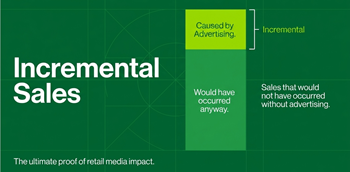
- Return on Ad Spend (ROAS) misleads in any category with strong base sales, frequent promotions or short purchase cycles. The number looks great because the products were going to sell anyway. The relevant measure is the extra sales the ad caused.
- The framework default is the strictest way to count only sales of the exact item advertised. Same brand sales in the same retailer category can be reported separately, and broader cross-category sales can be reported separately again, with the assumptions disclosed.
- Online and in-store outcomes should be reported separately first, then combined for the brand-level view.
Manish Shama from Think Blue said it clearly, “Grocery and fresh food categories live and die by basket dynamics, and standard ROAS rarely captures that. The framework gives merchandising and private brand leaders a measurement vocabulary that finally fits how grocery actually sells.”
On the budget side, retail media is now a permanent budget line item that CFOs are expected to defend. FMI’s framework wants finance leaders to focus in on Incremental Return on Investment (iROI): the extra profit the ad caused, divided by what the ad cost. The framework is firm about math. Profit numbers must come from finance-approved margin and fee tables, not generic assumptions. If those inputs aren’t ready, the result gets labeled “Certified iROAS; Profit Pending.”
“CFOs are not asking for more dashboards. They are asking for fewer caveats,” said Drew Dabbelt, NIQ. “Tying retail media to incremental profit, with the disclosures the framework requires, is what moves the conversation from marketing math to finance math.”
For finance and merchandising leaders, the practical ask is short: require disclosure of identity coverage, the time window and the confidence range on every lift number. Report online and in-store separately before rolling up. And let iROI, not iROAS, anchor the budget conversation.
We invite you to download the report, read it and offer us feedback as we aim to support the food industry in maturing retail media together.
 Industry Topics address your specific area of expertise with resources, reports, events and more.
 Our Research covers consumer behavior and retail operation benchmarks so you can make informed business decisions.
 Events and Education including online and in-person help you advance your food retail career.
 Food Safety training, resources and guidance that help you create a company food safety culture.
 Government Affairs work — federal and state — on the latest food industry policy, regulatory and legislative issues.
 Get Involved. From industry awards to newsletters and committees, these resources help you take advantage of your membership.
 Best practices, guidance documents, infographics, signage and more for the food industry on the COVID-19 pandemic.
