Annual U.S. Grocery Shopper Trends Report Finds Consumers Value Grocery Shopping In-Person
Arlington, VA—FMI—The Food Industry Association today releases the U.S. Grocery Shopper Trends 2026 report, developed in partnership with The Hartman Group, finding that shoppers continue to value grocery shopping in-store. 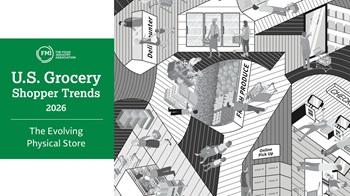 The report outlines elements of the evolving physical grocery shopping experience that build shopper loyalty and repeat visits.
“In an effort to fulfill their unique definitions of value, consumers visit more than five separate grocery store banners on average per month despite growing omnichannel grocery shopping trends,” said Leslie G. Sarasin, president and CEO of FMI. “Shoppers tell us they seek stores with certain personality traits that meet their household needs. One store may offer an entertainment-based shopping experience, while another offers stock-up options or bargain hunting. It’s important for food retailers to ask themselves, ‘What personality does my store have?’ and ensure that personality grows customer loyalty.”
“Consumer perspectives may shift with the times, but grocery shopping remains a positive and purposeful experience for Americans,” said Steve Markenson, vice president, research & insights for FMI. “Our research shows shoppers continue to find enjoyment and meaning in how and where they buy food, as evidenced by a consistent U.S. Grocery Shopper Sentiment Index, which tracks how Americans feel about grocery shopping.”
Frequently Asked Questions FMI's U.S. Grocery Shopper Trends 2026 Report Answers
What do consumers believe are the benefits of grocery shopping in person?
Grocery shopping in person gives consumers a greater sense of control, confidence, and efficiency, especially when choosing perishable items like produce and meat. Shopping in person also plays an important social role, helping consumers care for their households and stay connected to food, culture, and shared experiences.
What would consumers miss if they could not grocery shop in person?
If consumers could not grocery shop in-person, they report missing the ability to select products (48%), experience human connection (22%), have enjoyable experiences (22%), take advantage of the selection of products in the store (21%), find lower cost (20%), engage in discovery (17%) and ease of shopping (15%).
How does the in-store grocery shopping experience build loyalty?
In-store grocery shopping experiences that are intentionally designed to offer simple, efficient, enjoyable, clean, and non-overwhelming experiences tend to build shopper loyalty. Shoppers also return to stores that have a personality that meets their needs, like mass retailers allowing for bulk buying and specialty retailers offering cultural products.
Where do Americans prefer to grocery shop in person?
Most Americans (54%) report always shopping in-store at their primary store. Only 15% of consumers say they grocery shop at their primary store the same amount in-store and online.
When do grocery shoppers utilize technology in their grocery shopping experiences?
Technology is a seamless part of today’s grocery shopping experience. 77% of grocery shoppers use digital technology before shopping, and 71% use it while shopping.
How much do American households spend on groceries per week?
According to FMI’s U.S. Grocery Shopper Trends 2026 report, Americans spend on average $169 per week on groceries as of February 2026.
What type of store do Americans shop at for groceries?
According to FMI’s U.S. Grocery Shopper Trends 2026 report, 77% of Americans get their groceries from a supermarket, 67% from a Mass store, 45% from a Club store, 36% from a Limited Assortment store, 32% from a Dollar store, and 28% from an online-only retailer primarily.
How often do Americans shop for groceries?
Americans make 1.6 individual grocery shopping trips per week, with men making 1.6 trips and women making 1.5 trips. Households with children make 1.8 grocery shopping trips per week. In total, American households make 2.8 grocery shopping trips per week.
Do Americans shop for groceries at one primary store, or do they shop around?
Americans, on average, visit 5.4 separate banners in one month for grocery items. Gen Z and millennial Americans often shop around for grocery items, with most visiting 6.7 and 6.1 separate banners per week, respectively.
For Media
- Members of the media may contact FMI for a gratis copy of the U.S. Grocery Shopper Trends 2026 report.
- Methodology: FMI’s U.S. Grocery Shopper Trends 2026 report includes findings from a nationally representative survey fielded February 4-18, 2026, of 2,023 respondents and an online ethnographic study, including in-depth interviews, as well as draws upon The Hartman Group’s accumulated ethnographic research into U.S. food consumption and consumers.
 Industry Topics address your specific area of expertise with resources, reports, events and more.
 Our Research covers consumer behavior and retail operation benchmarks so you can make informed business decisions.
 Events and Education including online and in-person help you advance your food retail career.
 Food Safety training, resources and guidance that help you create a company food safety culture.
 Government Affairs work — federal and state — on the latest food industry policy, regulatory and legislative issues.
 Get Involved. From industry awards to newsletters and committees, these resources help you take advantage of your membership.
 Best practices, guidance documents, infographics, signage and more for the food industry on the COVID-19 pandemic.
