














.png?sfvrsn=a97e8803_1 "David Haaf Headshot- Update 2026 (2)")










.jpg?sfvrsn=a19ee2ab_1 "james-murphy (002)")





.png?sfvrsn=965437e5_1 "Dentons (2)")













.png?sfvrsn=89a4d009_1 "Bold Group (7)")
.png?sfvrsn=f10a00c_1 "Bold Group (5)")

.png?sfvrsn=beea939b_1 "Bold Group (4)")




FMI’s 2026 Legal, Regulatory and Compliance Conference covered the intersecting legal and regulatory issues shaping the food industry, including packaging, food ingredients, employment and technology.
By Matt McKinney, Director, Communications, FMI
 For food industry legal, regulatory and compliance leaders, the workday can feel like standing at the intersection of several fast-moving roads. New state laws are emerging before federal rules are finalized. The litigation burden is expanding as the number of suits against the food industry grows. Technology is reshaping employment, ecommerce and cybersecurity risk. And all of this is happening while the industry continues to focus on feeding families safely, affordably and reliably.
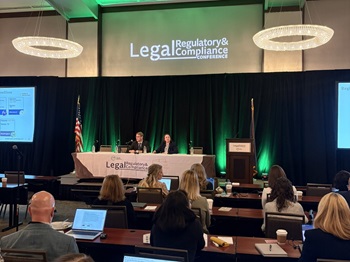
That was the backdrop for FMI’s 2026 Legal, Regulatory and Compliance Conference, held July 19–21 in Portland, Maine. The conference brought together legal counsel, compliance professionals, regulatory leaders and executives from across food retailers, wholesalers and product suppliers to examine developing issues specific to the food industry, with sessions spanning food labeling, labor, crisis management, litigation, state regulation and practical compliance planning.
Across the agenda, one message came through clearly: the most effective organizations are building cross-functional systems that connect legal, operations, merchandising, technology, communications, human resources, food safety and government relations. The issues facing the industry are too interconnected to manage in silos.
Extended producer responsibility (EPR) and packaging policy offered one example. As states continue to advance EPR programs and related packaging requirements, companies must understand not only whether a package is covered, but also how producer responsibility, material reporting, fee structures and overlapping state laws may affect business planning. The discussion underscored the importance of engaging early with packaging partners and tracking litigation that could shape how these laws are implemented.
Food regulatory developments reflected a similarly complex landscape. Speakers examined the growing focus on ingredients, ultra-processed foods, Generally Recognized As Safe (GRAS) reform, front-of-package labeling, allergens, heavy metals and traceability. These conversations are unfolding amid public scrutiny around health, affordability and transparency, as well as state-level activity on ingredient restrictions and SNAP-related proposals.
The conference also looked beyond traditional food and labeling issues. Loyalty programs, ecommerce and artificial intelligence can enhance the shopper experience but must be approached thoughtfully to mitigate risk. Employment policy discussions covered labor standards, immigration, workplace agreements and the use of technology in hiring and managing the workforce. A cybersecurity briefing and tabletop exercise emphasized that ransomware attacks and data breach responses are now central to legal preparedness.
Taken together, the conference reinforced a practical truth: the food industry’s legal environment is not defined by one headline issue. Legal and regulatory professionals must remain informed on food safety, technology, labor, data protection, sustainability, and much more. For food retailers, wholesalers and product suppliers, staying ahead means building policies and processes that are flexible, documented and coordinated.
FMI’s Legal, Regulatory and Compliance Conference provided more than a review of current developments. It offered a roadmap for operating in a new legal era—one where preparedness, transparency and cross-functional collaboration are essential to protecting consumers, serving communities and sustaining confidence in the food supply.